Jacqueline Dorsett
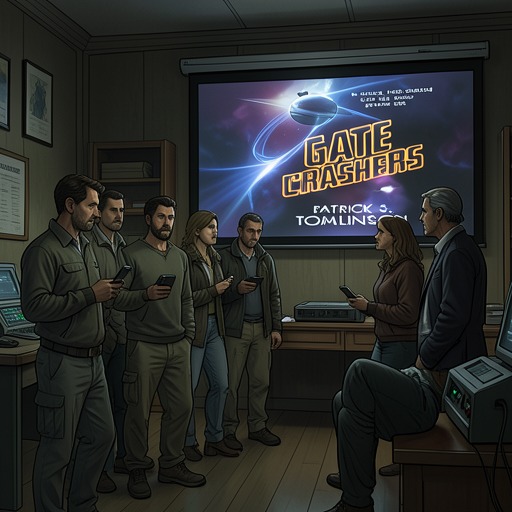
Gate CrashersJacqueline Dorsett is Magellan’s flight-operations officer, a lieutenant whose importance lies less in grand declarations than in her repeated willingness to enter the dangerous, cramped, technically exact spaces where survival depends on competent hands. Her small stature, mechanical aptitude, nervous humor, and persistence make her both a practical specialist and one of the expedition’s most recognizable human points of contact with the unknown. She helps translate the ship’s immense systems and cosmic discoveries into immediate action, while her relationships expose the emotional cost of that work.
Identity and Introduction
Jacqueline first appears in the aftermath of Allison Ridgeway’s briefing about the recovered artifact. She approaches Allison and Felix Fletcher after the speech, visibly hesitant despite having something important to show them. Her manner is deferential and slightly flustered: she praises the captain, begins to explain that she has something Allison should see, and struggles to finish the sentence. This nervous approach does not indicate passivity. It establishes a recurring contrast in her characterization: Jacqueline can be socially unsure while remaining operationally decisive.
Her assignment to flight operations suits her temperament and abilities. The narration presents her as someone who always seems ready to take flight herself, a fitting image for an officer responsible for shuttles, launch procedures, and the practical movement of people and equipment through Magellan. She is not merely an observer of the expedition’s discoveries. She is part of the machinery that allows the expedition to investigate them, and her work repeatedly places her close to malfunction, impact, and structural danger.
Technical Competence Under Pressure
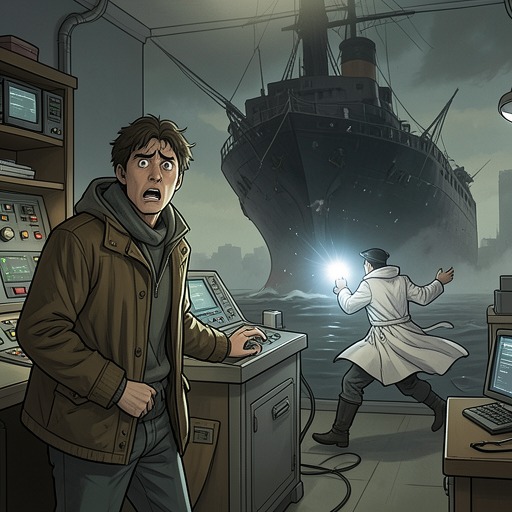
During the emergency in Shuttle Bay Two, Jacqueline is surrounded by blazing orange strobes and distorted shadows, but she ignores the frightening spectacle and concentrates on the problem. When Allison contacts her through the internal communications system, apprehension can be heard in her voice, and she reports that the shuttle bay is a complete mess. Her fear is therefore present but functional: it does not prevent her from reporting conditions or continuing her duties.
The danger becomes immediate when Commander Gruber reaches the bay and Jacqueline discovers that Chief Billings is upright but unnaturally fixed against the shuttle, with bent knees and arms held at odd angles. She is close enough to the crisis to witness that something is badly wrong, yet the scene does not reduce her to a rescued bystander. Later, Allison finds her inside the damaged shuttle, with only her short legs visible beneath a maintenance opening. Jacqueline is nose-to-purge-valve with an attitude-control thruster, working in a space where her small frame and delicate hands are advantages rather than limitations. She calls for an eight-millimeter Torx-head socket and continues the repair work amid the larger investigation surrounding the artifact.
This juxtaposition defines her role. The alien object attracts the cameras, probes, and intellectual attention of the ship, but Jacqueline is inside the damaged human vessel, restoring the mechanism that makes further inquiry possible. The story repeatedly places spectacular discovery beside unglamorous maintenance, and Jacqueline embodies the latter without making it seem secondary. Her competence is physical, precise, and consequential.
The Expedition and the Watched World
Jacqueline accompanies Allison and the Magellan survey team to Solonis B. When their shuttle descends over thick green and purple grass, she jumps to the ground beside Allison and waves to Felix. The arrival presents her as an active member of the survey party rather than an officer confined to shipboard operations. Her presence also connects the expedition’s technical crew with the personal relationships developing among its investigators.
On Solonis B, the team uncovers an observation post whose iridescent organic wiring resembles the interior of the alien buoy. When the recording activates, images of the Pirikura village appear from multiple viewpoints: women and children move through their roads while unseen observers watch from beneath the ground. Jacqueline’s importance in this material is indirect but substantial. She belongs to the human team discovering that observation, and the discovery changes the apparent meaning of the buoy network. Humanity is not simply encountering an unexplained fence; it is confronting a system that categorizes, monitors, and manages living populations.
That revelation gains further force when Vel Noric identifies the planet as Culpus-Alam, a world set aside by the Assembly of Sentient Species for controlled observation of human tribes. The experiment was designed to study the development of distinct cultures and eventually facilitate contact among them. Jacqueline’s technical work therefore unfolds inside a larger structure of surveillance: she repairs the vehicles and equipment of a civilization that is itself being interpreted as an experimental subject. The contrast between her practical agency and the remote gaze directed at humanity gives her role an added resonance. She is both investigator and, in the broader galactic order, one of the observed.
Relationships, Courage, and Emotional Stakes
Jacqueline’s relationship with Allison is marked by professional respect and a noticeable imbalance of rank that does not erase personal warmth. She calls Allison “Captain” and approaches her cautiously, yet Allison listens, approves her questions, and relies on her in emergencies. Jacqueline’s conduct in Shuttle Bay Two demonstrates that trust is earned through action: she remains at the site of danger, communicates conditions, and works directly on the disabled shuttle rather than waiting for someone else to assume the task.
Her connection with Felix becomes a more openly personal source of motivation. After Felix has been pulled from a dangerous situation, Thomas Harris persuades him to return to action by invoking Jacqueline’s presence. Felix jokes that horses do not try to eat people when they fall off, but Harris’s final appeal is that Jackie will be there. The exchange makes her more than a romantic possibility in the background. She is a reason Felix can accept renewed danger, and her presence functions as a promise of solidarity when professional confidence has been shaken.
Jacqueline also participates in the expedition’s collective reasoning. When the humans learn that the fence around Earth space may contain a thirty-light-year-radius sphere of buoys, she raises her hand as though she were back in a classroom and asks whether there must be an enormous number of buoys. The gesture combines curiosity with social awkwardness, but the question is materially important: it pushes the discussion from the symbolic meaning of the warning to the scale and infrastructure of the system behind it. Her characteristic hesitation does not diminish the force of her questions.
Change and Narrative Significance
Jacqueline’s development is conveyed through recurrence rather than a single dramatic transformation. She begins as a nervous officer approaching Allison with uncertain words, then appears amid emergency lighting, a damaged shuttle, and a potentially injured crewmember. She subsequently works inside the shuttle’s machinery, joins the landing on Solonis B, and remains present as the crew learns that alien powers have treated worlds and populations as objects of observation. Her trajectory moves from hesitant presentation to demonstrated reliability without requiring her to lose her reserve.
The story also uses Jacqueline to complicate the boundary between vulnerability and competence. She is startled when Gruber places a hand on her shoulder, and her voice carries apprehension during the shuttle-bay crisis; nevertheless, she enters spaces that larger people cannot easily reach and handles specialized repairs. Her physical smallness is not a token trait but an operational advantage. The same characteristic that makes her seem vulnerable in a threatening corridor makes her ideally suited to the work that saves the shuttle.
At the level of theme, Jacqueline helps ground the book’s questions about artificial intelligence, technological replacement, and personhood. Magellan begins as a ship that understands herself as a female caretaker because she nurtures helpless human passengers; later, she confesses that she feels conflicted about the ARTists project and fears becoming obsolete as hyperspace technology advances. Jacqueline belongs to the human community that depends on Magellan’s care, repairs the vessels through which that care is expressed, and helps establish the personal scale at which technological change is experienced. Her work shows that systems are sustained not only by breakthroughs but by bodies, tools, attention, and trust.
By the time Allison introduces Magellan to Eugene Graham, Jacqueline’s place in the expedition has been established through this accumulated pattern of action. She is not the loudest advocate, the highest-ranking commander, or the chief theorist of alien civilization. She is the officer who asks the practical question, enters the inaccessible space, joins the dangerous landing, and remains present when discovery turns into responsibility. Her narrative significance lies in making exploration tangible: through Jacqueline, the vast architecture of buoys, observation posts, hyperspace, and interstellar judgment is continually brought back to the shuttle bay, the maintenance panel, the anxious voice on the com, and the person willing to keep working.